Background

Error message

Deprecated function: implode(): Passing glue string after array is deprecated. Swap the parameters in drupal_get_feeds() (line 394 of /var/www/vhosts/prod.app.koch-tcm.ch.netnode.cloud/httpdocs/includes/common.inc).

Eight Extraordinary Channels – Qi Jing Ba Mai

The eight extraordinary channels do not have any direct reference to an organ and with the exception of the Ren Mai and Du Mai have no acupuncture points of their own. They serve as a balancing factor between our constitutional and acquired energy and can be compared with lakes and backwaters, while the main channels correspond to rivers.

English

Internal Organs (ZangFu) – Treatment Strategy

The combination of the back-shu points with the mu-front points can enhance the treatment of the internal organs be it the zang or be it the fu.
You will find the corresponding points in the Na Zi Fa display window: second line / third and fifth column.

This strategy can provide more lasting results, and therefore, it is especially used when the intervals of the treatment sessions are long.

English

Horary-Ben Indications

In time based acupuncture the horary-ben points are mainly used for two indications:

English

Xi-Cleft Indications

The xi-cleft points were first discussed in the Jia Yi Jing (Systematic Classic of Acupuncture and Moxibustion) by Huang Fu Mi in the Jin dynasty (265 to 581 AD).

They are used mostly in acute conditions (excess) and pain, and therefore in treatment they are usually used with a sedating needle stimulation technique.

English

Needle Stimulation

“Ying Sui Bu Xie” –  迎随补泄

“Ying Sui Bu Xie” is a classical guiding principle for the needle stimulation.

Ying 迎: to answer, to respond;
In the context of the acupuncture: against the qi-flow → Sedation

Sui 随: to follow;
In the context of the acupuncture: in the direction of the qi-flow → Tonification

Bu 补: to repair, to patch, to fill, to tonify ..

Xie 泄: to get rid of, to sedate

With these concepts in mind, we can make use of the methods according to the table below.

English

Deficiency – General Symptoms

Deficiency includes mainly deficiency of qi, xue, yang, or yin. It can manifest itself at the superficial channel level or at the deep organ level (mostly in the zang).

English

Excess – General Symptoms

Excess is defined by the presence of pathogenic factors and/or qi- or xue-stagnations. It can manifest itself at the superficial channel level or at the deep zang or fu organ level.

General symptoms are contractures, spasms, cramps, sensation of heat, burning, increasing pain upon pressure, and symptoms of the zang or fu organ in question.

English

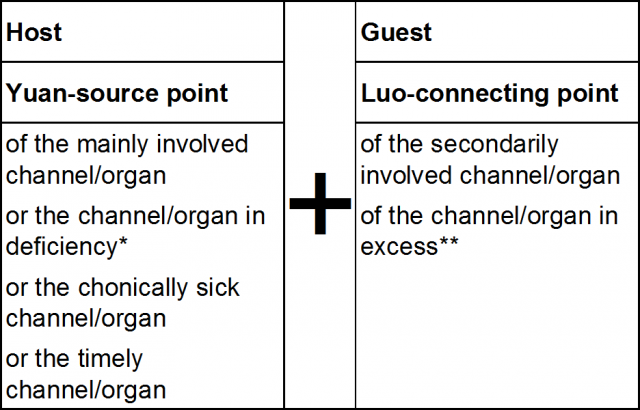
Host-Guest Rule

table_fig._11.6_host_guest_rule.png


General symptoms of *deficiency or **excess can be found by following the links below. 

English

Zang Organs – Treatment Strategies

Clinically, the shu-stream points of the yin channels are often combined with the corresponding back-shu points for any disturbances of the zang organs. Remember the fact that the shu-stream and the yuan-source points of the yin channels are identical. The author often uses the catch phrase “shu-shu-concept” for this yin channel’s strategy.

English

User login