Background

Error message

Deprecated function: implode(): Passing glue string after array is deprecated. Swap the parameters in drupal_get_feeds() (line 394 of /var/www/vhosts/prod.app.koch-tcm.ch.netnode.cloud/httpdocs/includes/common.inc).

Horary-Ben Point, Mother Point, Child Point - Key Terms of Tonification and Sedation

The horary-ben point, the mother point or tonification point, and the child point or sedation point are key terms of any concept of tonification and sedation.

English

He-Sea Indications

According to their classical indications, the he-sea points are used for two groups of conditions:

Rebellious Qi and Diarrhea, Diseases of the Stomach, Diseases of the Fu Organs

This first group of indications applies more to yang channels than to yin channels. However, the he-sea points of the yin channels of the leg can treat all fu organs as well.

English

Jing-River Indications

According to their classical indications, the jing-river points are used in the following conditions:

Cough and Dyspnea

This indication is found in the Nan Jing, chapter 68.

Problems of the Voice and the Throat

This indications is found in the Nan Jing, chapter 68, as well as in the Ling Shu, chapter 44.

English

Seasonal Indications of the Five Transporting-Shu Points

The five transporting-shu points can be used according to the seasons.
In the Ling Shu you will find: "In winter use the jing-well points, in spring use the ying-spring points, in summer use the shu-stream points, in late summer use the jing-river points, in autumn use the he-sea points."

English

Shu-Stream Indications

According to their classical indications, the shu-stream points of the yin channels have to be viewed separately from the shu-stream points of the yang channels.

The shu-stream points of the yin channels are the primary points for zang organ indications. This is mainly determined by the fact that on the yin channels the shu-stream points are identical with the yuan-source points.

English

Element Indications

Five Elements ~ Pathogenic Factors

According to references in the classics, there is a correspondence of the five elements and pathogenic factors. According to this correspondence, the five element points can be used to expel the relevant pathogenic factor (whether interior or exterior) with the only exception of the metal point.

English

Ying-Spring Indications

The ying-spring points, on the one hand, clear and steady heat, they treat fever and sicknesses that result in changes in coloring of the face.
On the other hand, they can be used in diseases of the yang channels and in diseases of the zang (together with the shu-stream point).

The ying-spring points lie in between the jing-well and the shu-stream points. In analogy to the location, the classical indications of this point category tend to these two directions, namely to the preceding jing-well and the following shu-stream point category.
English

Jing-Well Indications

The classical indications of the jing-well points are heat symptoms, dullness as well as fullness below the heart region, disturbance of the spirit.

References to the Classics (Chapter):

[1] Ling Shu (4, 6 and 44). [2] Nan Jing (68)

English

Sedation – Xie – 泄

Sedation makes sense in the case of syndromes of excess.

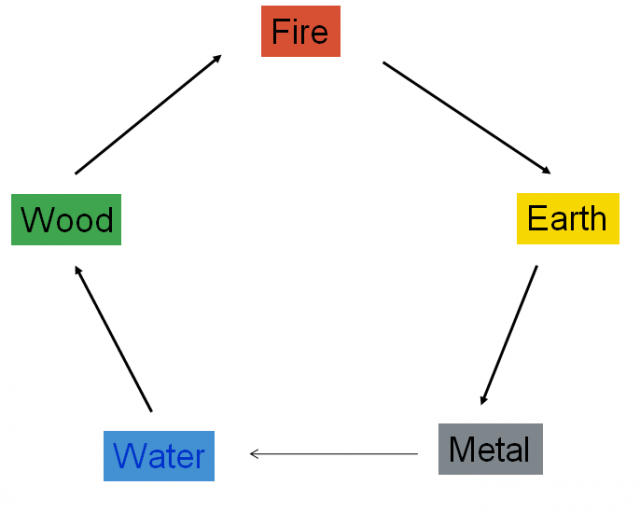
The generating cycle  – xiang sheng – 相生 

The generating-sheng cycle is the basis for any tonification or sedation strategy which probably is the most commonly used strategy in the Na Zi Fa.

English

The Generating Cycle – Xiang Sheng – 相生

The generating-sheng cycle is the physiological sequence of  the five transformational phases or five elements.

table_fig._11.2_generating_cycle.png

Each transformational phase generates and nourishes the following transformational phase.

English

User login